Grade Chart Assignments Without the Late Nights
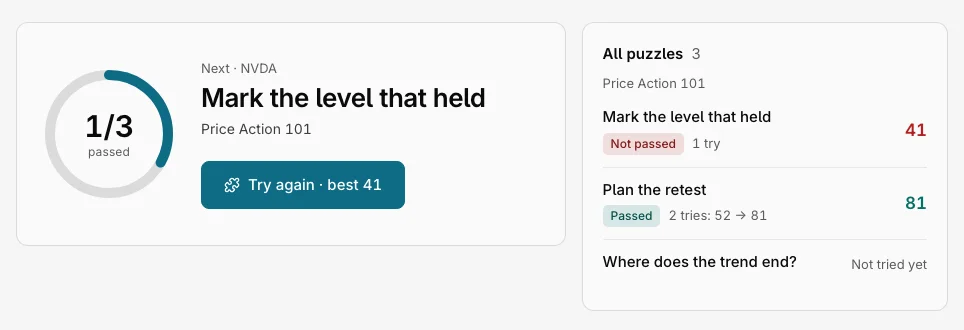
Grade chart assignments with tolerance scoring instead of multiple choice. See how trading educators assess drawings at scale without hand-grading every one.
Grade Chart Assignments Without the Late Nights
If you run a trading course, you already know the problem. You teach support and resistance on Monday, assign a chart for homework, and then sit down Tuesday night with forty screenshots in your inbox. Every line is slightly different. Every student wants feedback. And you still have to prep Wednesday's lesson. The question that keeps coming back is simple: how to grade a chart assignment without losing your evenings to it.
Multiple choice was supposed to fix this. It did not.
Why Multiple Choice Fails for Chart Homework
A four-option quiz can test whether someone remembers what a head-and-shoulders pattern is called. It cannot test whether they can find one on a live chart, draw the neckline in the right place, or distinguish it from a pattern that almost looks right but is not.
Technical analysis is a spatial skill. The answer is not a letter — it is a line drawn at a specific price, on a specific timeframe, on a specific instrument. When you grade technical analysis homework with multiple choice, you are testing vocabulary, not the skill you actually taught.
Most of us figure this out fast. The ones who stick with multiple choice do it because hand-grading chart drawings does not scale and they have not found another option. The ones who drop assessment altogether do it for the same reason.
Neither outcome is good for the class.
What It Means for the Answer to Be a Drawing
Think about what you are really asking when you assign a chart exercise. You want the student to open a chart, identify something, and mark it. The answer is the mark itself: a trendline, a horizontal level, a zone, a shape.
That means the grading system has to understand where the drawing sits relative to where it should sit. Not whether the student clicked "B" on a quiz, but whether the line they drew falls within an acceptable range of the correct placement.
This is the idea behind tolerance-based grading. You set a reference answer — the drawing you consider correct — and the system scores each submission by how close the student's drawing lands to yours. A line placed two ticks away from the reference scores differently than one placed two hundred ticks away. The assessment becomes spatial, which matches the skill.
How to Grade a Chart Assignment With Tolerance Scoring
Coursework on Traderise is graded by the chart rather than by multiple choice: the student draws the answer and a tolerance score grades it. The student does not pick from a list. They draw on the chart, and the platform evaluates the drawing against the reference you set when you built the task.
The chart is not decoration — it is the exam paper. The drawing is not supplementary — it is the answer.
For the teacher, this changes the workflow between lessons. You are no longer opening screenshots, eyeballing lines, and typing individual feedback. The tolerance score handles the spatial comparison. You review the scores, spot the students who are consistently off, and focus your attention where it is needed.
Scaling Without Hand-Grading Every Submission
Scale is the reason this matters. A class of five students can survive on hand-grading. A class of fifty cannot, and a programme running multiple cohorts through the same curriculum certainly cannot.
The pattern that works: build the assignment once, attach it to the course, and let every enrolled student submit against the same reference. One practice account runs the whole course — you set the starting capital on the course, every student enrolled gets their own balance, open positions and closed trades, and it carries from one task to the next instead of starting over at each one. There is no broker to connect and no real money anywhere in it.
That continuity matters for assessment. When a student's practice account carries forward, you can see whether the skills from lesson three are still present in lesson eight. A system that resets the slate every time tells you less.
After the lesson, the room stays where you put it: attach it to one of the courses you run and everyone taking that course sees it there, or leave it as a private room that belongs to no course. Either way, the work lives inside the room your class answers back in, not in your email.
What You Get Back
The shift is not from grading to not grading. It is from grading drawings by eye to reviewing tolerance scores by number. You still look at outliers. You still intervene when a student is lost. But the baseline comparison — did the line land in the right zone — is handled before you open the dashboard.
What you get back is prep time. The hours that used to go to eyeballing forty trendlines now go to building better tasks, adjusting difficulty, and actually teaching.
If you want to see how tolerance scoring and the practice account work together inside a course, start at Traderise pricing and plans.
Traderise is educational and analytical software. Nothing on the site is investment advice, a recommendation, or a solicitation to trade.